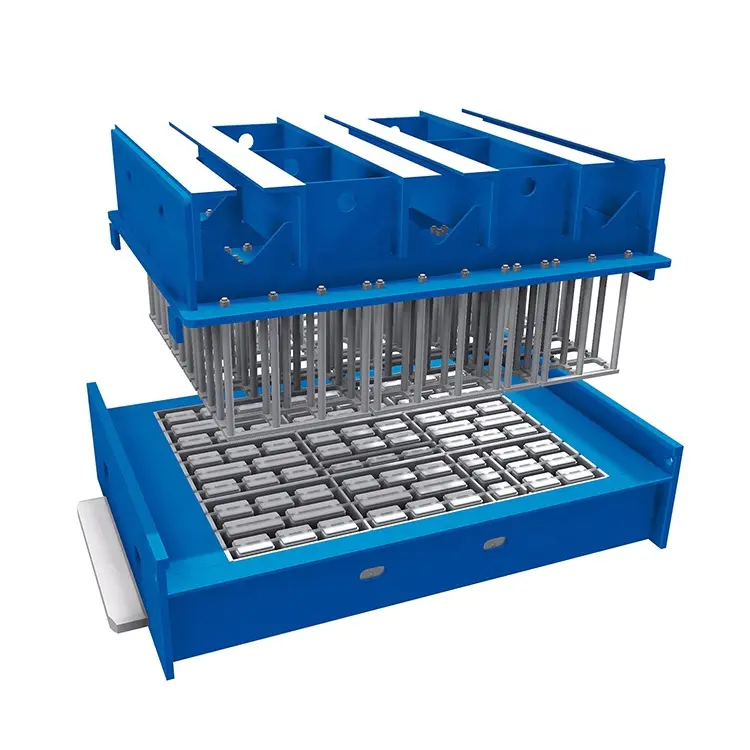

Selecting the correct material for your brick making machinery mould is not just a technical detail—it is the core determinant of your production efficiency, product quality, and long-term profitability. In over two decades of service in this industry, we at Fujian Quangong Mould Co.,Ltd have seen that the mould material directly impacts wear resistance, dimensional accuracy, and the ability to withstand high vibration and pressure. A mould made from substandard material will lead to frequent downtime, inconsistent brick shapes, and higher operational costs. This guide will walk you through the metallurgical and mechanical considerations to ensure your investment delivers maximum return.
The choice hinges on understanding the abrasive nature of your raw materials (like crushed stone, slag, or recycled aggregates), the required production speed, and the type of bricks you manufacture—whether pavers, hollow blocks, or interlocking bricks. Our factory has engineered thousands of moulds for diverse global conditions, and we know that a one-size-fits-all approach fails. In this article, we will break down the properties of different steel alloys, hard chrome plating, and heat treatment processes, giving you a clear roadmap to specify the right Brick Making Machinery Mould for your plant. By the end, you will be equipped to have informed discussions with suppliers and make a decision that aligns with your business goals.
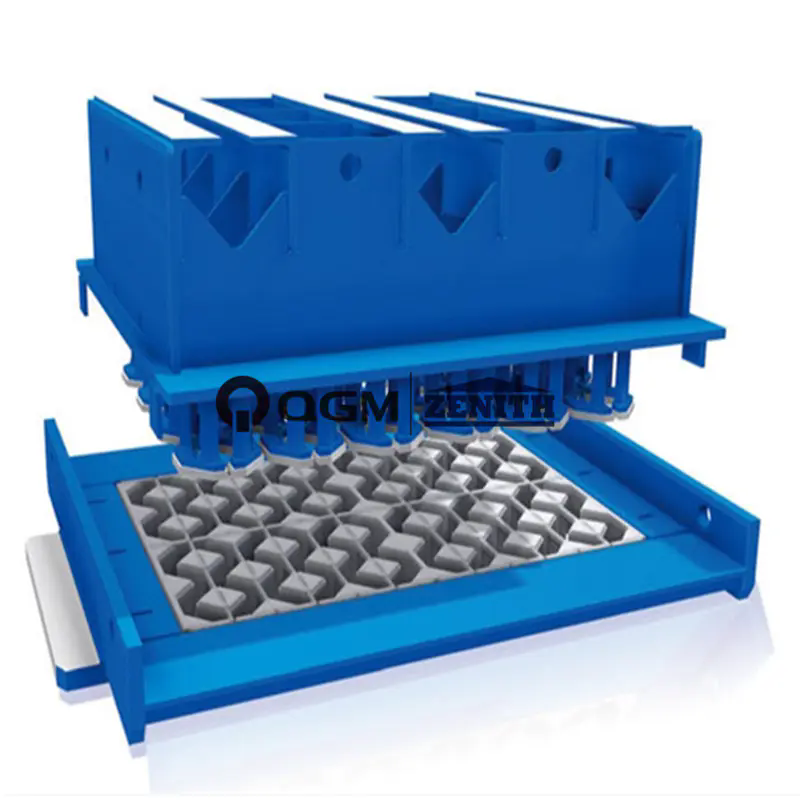
When our engineering team sits down to design a new Brick Making Machinery Mould, the first question is always about the operational environment. The material choice is not arbitrary; it is a calculated response to several interdependent variables. Getting this right ensures that the mould performs optimally for hundreds of thousands of cycles. Below, we break down the primary factors that influence this critical decision.
The raw materials you use—whether it is river sand, crushed granite, limestone, or recycled demolition waste—have different levels of abrasiveness. Highly siliceous aggregates act like sandpaper on the mould surface. For such conditions, our factory often recommends moulds with a base material of high-carbon steel combined with a hardened surface layer. If you are using recycled materials with metal fragments, the wear rate increases exponentially, necessitating the toughest grades like tool steel (D2 or equivalent).
Are you running a small operation producing 2,000 bricks per day, or a high-capacity plant aiming for 20,000+ blocks per shift? For high-volume production, the mould material must resist fatigue. High-speed machines generate more heat and stress. In such cases, our moulds use high-strength alloys that maintain their integrity under continuous impact. For lower volumes, a cost-effective medium-carbon steel might suffice, but for industrial-scale output, we always suggest investing in premium materials to avoid premature failure.
Intricate designs with thin walls, deep grooves, or sharp corners require materials that can be machined to tight tolerances and maintain those tolerances over time. For interlocking bricks or pavers with complex profiles, the mould material must have excellent machinability and stability during heat treatment. Our factory uses CNC machined pre-hardened steel for such complex Brick Making Machinery Moulds, ensuring every cavity is identical and durable.
If your plant operates in a humid coastal area, corrosion resistance becomes a factor. While standard steels can rust, incorporating elements like chromium not only increases hardness but also offers some corrosion protection. For extreme conditions, our team might recommend a stainless steel liner or a specialized coating to prevent pitting.
By evaluating these four pillars—abrasion, volume, complexity, and environment—we create a material specification that balances upfront cost with total cost of ownership. Remember, a cheap mould that wears out in six months is far more expensive than a premium mould that lasts three years. At Fujian Quangong Mould Co.,Ltd, we guide our clients through this analysis, ensuring the material selected is precisely aligned with their production reality.
Hardness is often the first spec people look at, but it is only one part of the story. In the context of a Brick Making Machinery Mould, we need to consider the relationship between hardness, toughness, and wear resistance. A material that is too hard can be brittle and crack under the high compressive forces of a block machine, while a material that is too soft will deform and lose its edge. Here is why getting this balance right is crucial for your bottom line.
Wear in brick moulds occurs through two primary mechanisms: abrasion and impact. Abrasion happens as the aggregate particles slide against the mould walls during filling and demoulding. Impact wear occurs during the vibration and compression phases. The ideal material has a hard matrix to resist abrasion, but sufficient toughness to absorb impact without micro-fracturing.
If you select a material with insufficient wear resistance, the mould dimensions will change over time. This leads to:
On the other hand, a material that is too brittle can crack at the corners, leading to complete mould failure and costly downtime. This is why our engineering team at Zenith emphasizes a holistic view. We don't just look for the hardest steel; we look for the right steel, processed correctly. For example, we often use nitriding or hard chrome plating on the working surfaces of our Brick Making Machinery Moulds to achieve extreme surface hardness (over 70 HRC for chrome) while maintaining a tough, shock-absorbing core. This composite approach extends mould life significantly, often by 200-300% compared to untreated steel.
To make an informed decision, you need a clear comparison of the materials available in the market. Below, we provide a detailed breakdown of the most common grades used in brick making machinery moulds, including their properties, advantages, and typical applications. This comparison is based on decades of experience in our factory, where we have tested these materials under real-world conditions.
The following table outlines the key parameters you should consider. Note that the values can vary based on specific heat treatment.
| Material Grade | Hardness (HRC) | Toughness | Wear Resistance | Typical Application | Relative Cost |
| Mild Steel / C45 | ~20 (unhardened) | High | Poor | Non-wear parts, backing plates | Low |
| Case-Hardening Steel (20MnCr5) | 58-62 (case) / 30-35 (core) | Good | Good | General block moulds, liners | Medium |
| Quenched & Tempered (42CrMo4) | 48-52 (through-hardened) | Very Good | Good | Heavy-duty frames, punch holders | Medium |
| Tool Steel (D2 / Cr12MoV) | 58-62 (through-hardened) | Moderate | Excellent | High-wear liners, complex profiles | High |
| Hard Chrome Plated Surfaces | 65-70 (surface only) | Base dependent | Superior | Pavers, high-gloss finish bricks | High |
The choice between these materials often involves a trade-off. Higher initial cost usually translates to longer life and less downtime. At Fujian Quangong Mould Co.,Ltd, we help you analyze your cost-per-brick rather than just the mould price, ensuring you get the most economical solution over the lifespan of the equipment. Our experience shows that investing in a higher-grade material for the wear parts of the mould pays for itself within months through reduced maintenance and consistent quality.
Choosing the right material for your brick making machinery mould is a strategic decision that impacts every aspect of your production. It requires a clear understanding of your raw materials, production targets, and product specifications. Whether you need the toughness of 42CrMo4 for structural frames or the extreme wear resistance of D2 tool steel for liner plates, the key is to match the material to the specific function within the mould. At our factory, we integrate these material choices with precision machining and stringent quality control, ensuring that every mould we deliver performs at its peak. Remember, the goal is not just to buy a mould, but to invest in a tool that guarantees your plant's productivity and profitability.
Ready to optimize your block production? Contact Fujian Quangong Mould Co.,Ltd today for a consultation. Let our engineering team analyze your specific needs and recommend the ideal material for your next Brick Making Machinery Mould. We are here to help you build better, faster, and more efficiently. Request your quote now and experience the QGM difference.
Partner with Fujian Quangong Mould Co.,Ltd
Get a custom material recommendation for your Brick Making Machinery Mould. Contact our sales team today for a quote.
Q1: How does the type of aggregate I use affect the choice of steel for my brick making machinery mould?
A: The aggregate's abrasiveness is the primary factor. Aggregates with high silica content (like granite or quartz) are extremely abrasive and will quickly wear down standard steel. For such materials, you need a mould with high wear resistance, such as those made from tool steel (e.g., Cr12MoV) or with a hard chrome-plated surface. Softer aggregates like limestone allow for the use of case-hardened steels (e.g., 20MnCr5). If you use recycled aggregates that may contain metal or glass fragments, we at Fujian Quangong Mould Co.,Ltd strongly recommend opting for the highest wear-resistant grades to prevent rapid erosion of the mould cavities.
Q2: Can I use the same mould material for producing hollow blocks and interlocking pavers?
A: While technically possible, it is often not optimal. Hollow blocks typically require moulds that withstand high impact and have good toughness, making quenched and tempered steels like 42CrMo4 a good choice. Interlocking pavers, on the other hand, demand high dimensional accuracy and a superior surface finish. For pavers, a mould with a hard chrome-plated surface is superior because it provides a slick finish, reduces friction, and ensures the complex shapes demould cleanly. Using a standard steel mould for pavers may lead to rough edges and faster wear. Our factory produces specialized Brick Making Machinery Moulds tailored to the product type for this very reason.
Q3: What is the expected lifespan of a brick mould made from high-quality tool steel versus standard case-hardened steel?
A: Under similar high-abrasion conditions, a tool steel mould (like D2) can last 3 to 5 times longer than a standard case-hardened steel mould. For example, a case-hardened mould might produce 300,000 to 500,000 bricks before showing significant wear, while a tool steel mould with proper heat treatment from our factory can often exceed 1.5 million cycles. However, tool steel is more brittle and requires careful handling. The lifespan also depends on maintenance. In less abrasive applications, the difference may be smaller, making case-hardened steel a more cost-effective choice. We always recommend evaluating your specific output goals to determine the best material.
Q4: How does heat treatment affect the performance of the mould material?
A: Heat treatment is what unlocks the potential of the steel. Raw steel has a relatively soft structure. Through processes like quenching and tempering, we can achieve the desired hardness (e.g., 48-52 HRC) and relieve internal stresses. For case-hardening steels, a carburizing process adds carbon to the surface layer, which is then hardened to 58-62 HRC while the core remains tough. Incorrect heat treatment can lead to distortion, cracking, or insufficient hardness. At Fujian Quangong Mould Co.,Ltd, we use precisely controlled vacuum furnaces to ensure every Brick Making Machinery Mould achieves uniform hardness and dimensional stability, directly translating to longer life on your machine.
Q5: Is hard chrome plating always better than using solid tool steel for a brick mould?
A: Not always; it depends on the application. Hard chrome plating offers an extremely hard (up to 70 HRC) and low-friction surface, which is excellent for producing smooth, high-gloss pavers and for materials that tend to stick. It is a surface treatment applied to a base steel (like 42CrMo4). This gives you a tough core and a hard shell. Solid tool steel, however, offers high hardness throughout the material, which is beneficial when the wear is so severe that it might wear through a thin chrome layer. For extreme abrasion, tool steel is superior. For excellent surface finish and good wear life, chrome plating is ideal. Our engineers can advise on the best solution, and sometimes we combine both—using tool steel liners with a polished or plated finish for the ultimate performance.