

A brick machine mould is a steel cavity that is struck, vibrated, and scraped tens of thousands of times per month. The concrete mix abrades the cavity walls. The pressing stroke loads the mould head. The vibration cycles fatigue the welds and the corner radii. The steel that enters the machining line has the right chemistry, but it does not yet have the right properties for this duty. Heat treatment is the step that converts a machined block of alloy steel into a mould that can hold its dimensions and resist surface damage across a long production run. Without it, the cavity wears quickly, the block edges chip, and the mould is scrapped long before its designed cycle count.
Heat treatment improves performance through four linked effects. It raises the surface hardness so that the cavity resists abrasion. It keeps the core tough so that the mould does not crack under impact. It controls distortion so that the cavity dimensions stay within tolerance after the treatment. And it produces a consistent microstructure so that every mould from the same production batch behaves the same way in service. This article explains each effect, how the treatment stages produce it, how the main treatment routes compare, which parameters a buyer should specify, and how to verify the result before accepting a shipment. Our factory at Fujian Quangong Mould Co.,Ltd. operates the heat treatment process in house, and the guidance below reflects the process control and procurement questions we handle with our customers.
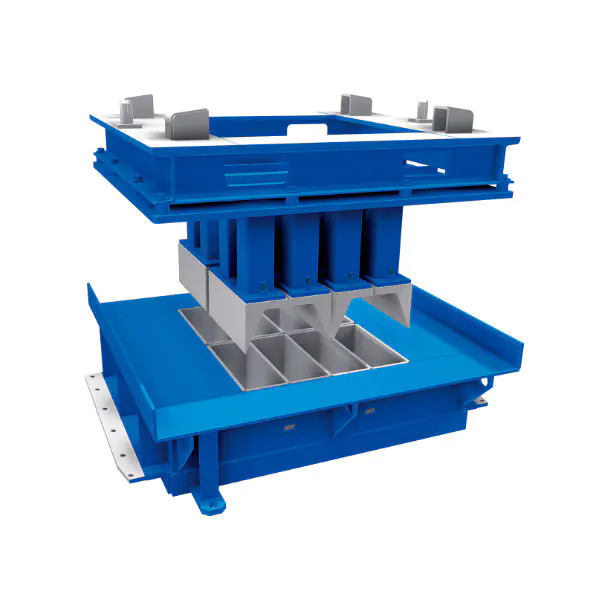
Consider a mould that was machined from a sound alloy steel and put into service without a controlled heat treatment. The first few thousand cycles look normal. Then the cavity edges begin to round over. The block corners chip, and the operator increases the vibration to compensate. The higher vibration loads the mould head, and a crack starts at a weld toe. Within a few months, the mould is removed from service, and the plant reports a "bad batch of blocks" when the real cause was the steel condition. This sequence is common, and it is the reason heat treatment is a performance specification rather than a finishing step.
The failure paths below show what happens when the steel properties do not match the duty.
The performance comparison below shows how the same base steel behaves with and without a controlled treatment.
| Property | Untreated or Poorly Treated Steel | Controlled Heat Treated Steel | Effect on Mould Performance |
| Surface hardness | Low to moderate | High and uniform | Longer wear life, cleaner block edges |
| Core toughness | Variable, may be brittle | Controlled and measurable | Resists cracking under impact |
| Microstructure | Coarse or banded | Fine and uniform | Better fatigue resistance |
| Distortion after treatment | High, requires rework | Controlled within tolerance | Stable block height |
| Batch consistency | Variable from mould to mould | Repeatable across the batch | Predictable maintenance planning |
Our factory treats the heat treatment as part of the mould specification, not as a subcontract service. We record the furnace, the cycle, and the results for every Brick Machine Mould we produce, so that the performance claim can be traced to a process record. The goal is to make the steel condition a controlled variable, not a source of field variation.
For a buyer, the practical lesson is that the material certificate alone does not predict mould life. Two moulds made from the same steel grade can perform very differently if the heat treatment differs. The procurement enquiry should therefore ask for the treatment route, the target hardness, the case depth if applicable, and the verification records, not just the steel grade.
Heat treatment works by changing the crystal structure of the steel and then locking that structure in place. The process is a sequence of controlled heating and cooling steps, and each step has a specific purpose. The timeline below follows a typical quench and temper cycle for a mould steel, with the metallurgical change and the performance effect at each stage.
The parameter map below links each stage to the measurement that confirms it was performed correctly.
| Stage | Key Control | Typical Range | Verification Measurement | Performance Effect |
| Preheat | Ramp rate and soak time | Controlled to section size | Furnace chart | Reduces thermal cracking risk |
| Austenitizing | Temperature and hold time | Per steel grade | Furnace chart, coupon test | Sets the achievable hardness |
| Quenching | Medium, agitation, time | Oil or polymer | Hardness survey | Determines martensite formation |
| Tempering | Temperature and time | Adjusted to the target hardness | Hardness test, impact test | Balances hardness and toughness |
| Surface treatment | Case depth and surface hardness | Specified per wear duty | Microhardness traverse | Raises wear resistance at the cavity |
Our process engineers at the furnace record the cycle for each load and retain the chart with the mould serial number. The chart is the evidence that the stages were performed as specified. Without it, a hardness reading alone cannot show whether the mould was properly austenitized or whether it reached its hardness through an incomplete transformation. The goal is to make the process reproducible, so that the second mould behaves like the first.
For a buyer, the stage map is a way to ask informed questions. A supplier who can explain the austenitizing temperature, the quench medium, and the tempering temperature for the specific Brick Machine Mould is a supplier who controls the process. A supplier who can only state a final hardness number is a supplier who may be reporting an outcome without controlling the route that produced it.
Three treatment routes dominate brick machine mould production: through hardening by quench and temper, case hardening by carburizing, and surface hardening by nitriding. Each route produces a different hardness profile through the section, and each profile suits a different wear pattern. The choice is not a matter of one route being better than the others. It is a matter of matching the profile to the duty.
The route comparison below sets out the profile, the typical values, the strengths, and the limits of each route.
| Route | Hardness Profile | Typical Surface Hardness | Typical Core Hardness | Best Suited To | Limitation |
| Quench and temper | Uniform through the section | 45 to 52 HRC | 45 to 52 HRC | General purpose cavities and mould heads | Wear resistance limited by the through hardness |
| Carburizing | Hard case, tough core | 58 to 62 HRC | 30 to 40 HRC | High abrasion cavities, pavers, curbstone moulds | Longer cycle, higher distortion risk |
| Nitriding | Very hard thin case, unchanged core | 60 to 65 HRC | Per base treatment | Precision cavities, low distortion requirement | Thin case, not suitable for heavy spalling |
The selection logic follows the wear mechanism. A cavity that sees uniform abrasion across the face benefits from a through hardened mould because the wear resistance is consistent even if the surface is reworked. A cavity that sees severe abrasion at the edges benefits from a carburized case because the hard layer is deep enough to survive edge loading. A cavity that requires tight dimensional control benefits from nitriding because the treatment temperature is lower and the distortion is smaller.
In our own production, the route is chosen during the design review and recorded on the mould drawing. A hollow block cavity that runs a moderate mix at a moderate cycle rate is often supplied in the quench and temper condition. A paver cavity that runs an abrasive mix at a high cycle rate is often supplied carburized. A precision curbstone cavity that must hold a tight height tolerance is often supplied nitrided after a quench and temper base. The route is part of the product definition, and it is quoted as such.
For a buyer, the route comparison is the basis for the technical discussion. The buyer should ask which route the supplier proposes and why, and should compare the proposal with the wear pattern observed on the existing moulds. A supplier who proposes a route without asking about the mix, the cycle rate, and the failure mode is a supplier who is applying a default rather than a design.
A heat treatment requirement is only useful if it is written as measurable parameters. A statement such as "hardened and tempered" leaves the furnace free to choose the temperature, the hold time, and the quench, and the resulting mould may not match the application. The specification should define the hardness, the case depth where relevant, the core properties, the distortion limit, and the records that the supplier must provide.
The specification table below lists the parameters that a buyer should include in the purchase order for a Brick Machine Mould.
| Parameter | Why It Matters | How to State It | Acceptance Evidence |
| Surface hardness | Controls abrasion resistance at the cavity | Range in HRC at a defined test location | Hardness survey report |
| Core hardness | Controls toughness under impact | Range in HRC at the core | Section hardness report |
| Case depth | Controls how long the hard layer survives | Effective depth in mm at a defined hardness limit | Microhardness traverse |
| Microstructure | Controls fatigue and crack initiation | Acceptance criteria per the applicable standard | Metallographic report |
| Distortion limit | Controls the block height tolerance | Flatness and cavity dimension limit after treatment | Dimensional inspection report |
| Process record | Allows traceability and diagnosis | Furnace chart retained with the serial number | Cycle chart and certificate |
The hardness location deserves particular attention. A reading taken on a machined face may differ from a reading taken at the cavity edge where the wear actually occurs. The specification should state the test location, the instrument, and the number of readings, so that the result can be compared across suppliers. The same principle applies to the case depth: the effective depth should be defined at a stated hardness limit, because the depth at which the case fades into the core depends on the limit chosen.
Our inspection team measures the hardness at the locations defined on the drawing and records the values in the mould report. For carburized moulds, the team performs a microhardness traverse on a coupon that is processed with the production load, and the traverse is attached to the certificate. The goal is to give the buyer a set of numbers that can be checked against the specification, not a general statement that the mould was heat treated.
For a buyer, the specification is the contract. A mould that meets the drawing dimensions but not the hardness and the case depth will wear out before its cycle count. The purchase order should therefore carry the thermal parameters as clearly as it carries the geometry, and the acceptance should be based on the records rather than on a visual check.
Verification should be a sequence of checks that move from the documents to the physical measurements and then to the process audit. The sequence below is the one we recommend to buyers who are qualifying a new mould supplier or auditing an existing one.
The verification matrix below maps each check to the risk it addresses and the action to take if the check fails.
| Check | Risk Addressed | Failure Indicator | Action |
| Certificate review | Missing or incomplete records | No test locations, no serial number | Request a complete certificate before acceptance |
| Specification comparison | Out of range hardness or case depth | Value outside the stated range | Hold shipment, request re-test or re-treatment |
| Process chart review | Uncontrolled cycle | Chart missing or inconsistent with the certificate | Escalate to the supplier quality function |
| Independent hardness check | Reporting error | Reading far from the reported value | Request a laboratory re-test |
| Furnace audit | Calibration drift | Expired calibration on furnace or tester | Require recalibration and re-verification |
Our quality function provides the certificate, the process chart, and the coupon traverse with each Brick Machine Mould shipment, and we welcome customer audits of our furnace and our inspection laboratory. The records are retained so that a mould delivered two years ago can still be traced to its treatment cycle. The goal is to make the verification straightforward for the buyer, because a heat treatment claim that cannot be verified is not a quality assurance measure.
For a buyer, the verification sequence should be written into the supplier qualification procedure. A supplier who can support the sequence is a supplier who can be relied on for repeat orders. A supplier who resists the request for the process chart or the calibration records is a supplier whose treatment quality cannot be confirmed, regardless of the certificate that accompanies the shipment.
Question 1: What hardness should a brick machine mould have after heat treatment?
Answer: The target depends on the treatment route. A through hardened mould is typically specified in the range of 45 to 52 HRC, which balances wear resistance with toughness. A carburized mould is typically specified at 58 to 62 HRC at the surface with a core of 30 to 40 HRC. A nitrided mould is typically specified at 60 to 65 HRC at the surface with the core properties set by the base treatment. The correct value depends on the mix abrasiveness, the cycle rate, and the failure mode observed on existing moulds, so the specification should be set with the supplier rather than copied from a catalogue.
Question 2: Why does a harder mould sometimes fail earlier than a softer one?
Answer: A harder mould can fail earlier if the hardness was achieved at the expense of toughness. A very hard but brittle mould head can crack under impact or under an uneven pressing load, and the crack can propagate into the cavity. The failure mode is different from wear, but the result is the same early removal. The correct specification balances surface hardness with core toughness, which is why the tempering stage and the core hardness are specified alongside the surface hardness.
Question 3: How does heat treatment affect the dimensional accuracy of a mould?
Answer: Heat treatment can change the dimensions through thermal expansion, phase transformation, and stress relief. A controlled cycle limits the distortion, and the final machining allowance is planned to remove the small movement that remains. Nitriding produces less distortion than carburizing because the treatment temperature is lower, which is why it is often chosen for precision cavities. The purchase order should state the allowable distortion so that the supplier can plan the process and the final machining accordingly.
Question 4: Can heat treatment compensate for a poor mould design?
Answer: Heat treatment can improve the wear resistance and the toughness of a sound design, but it cannot compensate for a design that concentrates stress at a sharp corner or that uses a section thickness that is too small for the load. In those cases, the mould will fail at the design weakness regardless of the treatment. The design review and the heat treatment specification should be handled together, because the treatment route is chosen to suit the geometry and the duty.
Question 5: What documents should accompany a heat treated mould shipment?
Answer: The shipment should include a certificate that states the treatment route, the hardness values with the test locations, the case depth if applicable, and the mould serial number. For carburized or nitrided moulds, the certificate should include the microhardness traverse or the case depth measurement. The supplier should also retain the furnace chart for the load and make it available on request. These documents allow the buyer to verify that the treatment matches the specification and to trace any field issue back to the process record.
Heat treatment improves the performance of a Brick Machine Mould by raising the surface hardness for abrasion resistance, keeping the core tough for impact resistance, controlling the distortion for dimensional stability, and producing a uniform microstructure for fatigue resistance. The treatment route, whether quench and temper, carburizing, or nitriding, should be selected to match the wear mechanism of the specific cavity. The specification should be written as measurable parameters, and the acceptance should be based on the certificate, the process chart, and the independent checks. Our factory at Fujian Quangong Mould Co.,Ltd. treats the heat treatment as part of the mould definition and provides the records that buyers need to verify the result. If you are sourcing Brick Machine Mould for an abrasive or high cycle application, contact our team to discuss the wear pattern and the treatment route for your cavity.
Contact Fujian Quangong Mould Co.,Ltd. today to discuss your Brick Machine Mould requirements and to request the heat treatment specification and verification records for your application.


 After-Sales Support